The Odyssey
Christopher Nolan has taken one of civilization’s oldest stories and given it nearly three hours, an army of extras and enough IMAX equipment to photograph a minor deity from orbit.
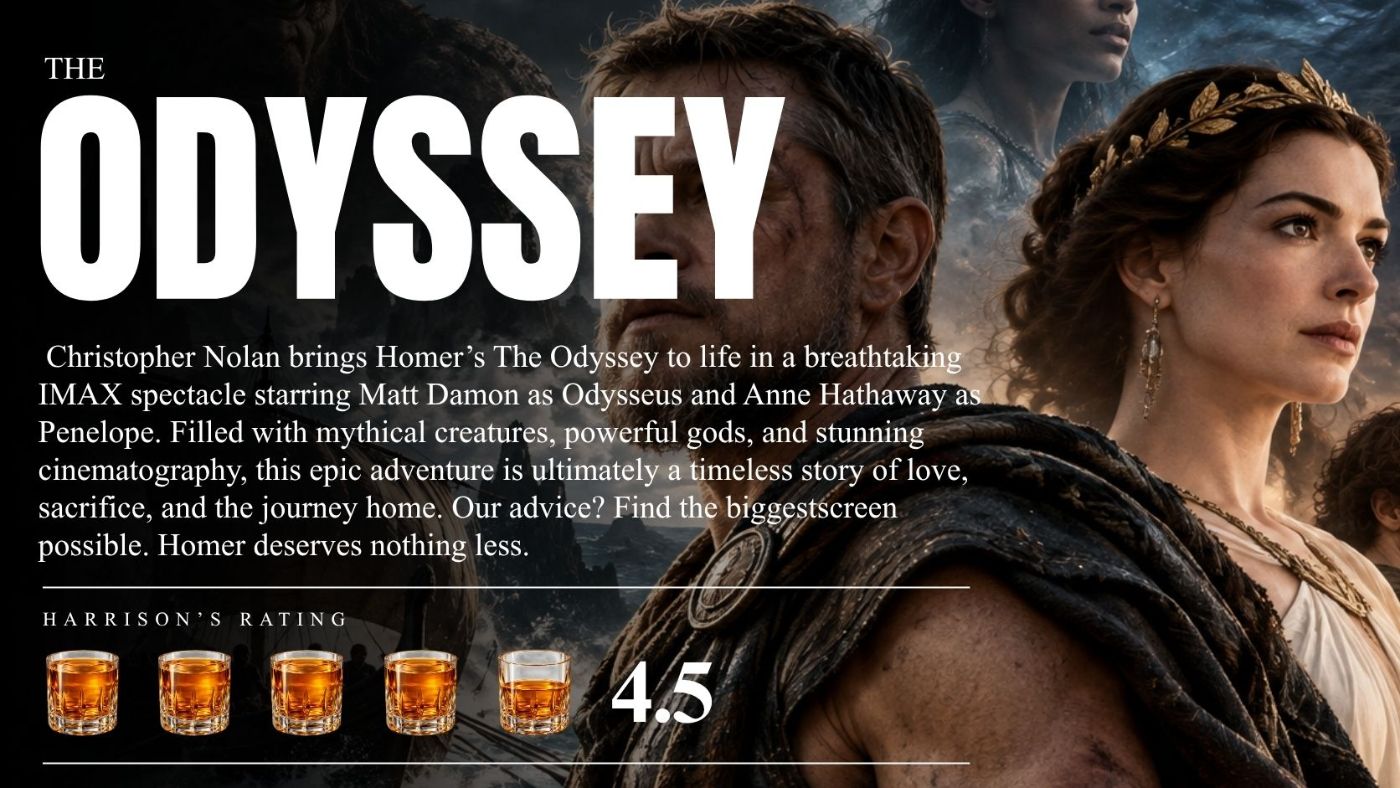
Christopher Nolan has taken one of civilization’s oldest stories and given it nearly three hours, an army of extras and enough IMAX equipment to photograph a minor deity from orbit. Matt Damon plays Odysseus, the king of Ithaca who has survived the Trojan War and would now very much like to return to his wife, Penelope, played by Anne Hathaway. Unfortunately, the Mediterranean has other plans involving monsters, storms, divine interference and a travel itinerary that makes connecting through Atlanta seem merciful.
At two hours and fifty-three minutes, The Odyssey requires commitment, although I have attended Palm Beach benefit auctions that ran considerably longer and contained fewer Cyclopes. Shot entirely with IMAX film cameras, it gives cinematographer Hoyte van Hoytema an enormous canvas for battered ships, unforgiving coastlines and exhausted faces. The Bronze Age evidently offered no reliable concierge service.
The production traveled through Morocco, Greece, Italy, Iceland and Scotland, and its commitment to physical filmmaking gives the adventure welcome weight. Odysseus’s principal vessel was a real, seaworthy ship, and the actors learned to row it. An admirable commitment to authenticity, although I would have negotiated an outboard. Even the Cyclops combines performer Bill Irwin’s work with animatronics, puppetry and computer graphics. The enormous creature belongs to a world of wet timber, rough stone and thoroughly unpleasant working conditions.
Yet the film gains its strength from Damon’s portrayal of a brilliant leader who has begun to suspect that cleverness cannot repair everything it damages. His Odysseus carries the confidence of a man accustomed to being the smartest person aboard, along with the fatigue and guilt that make that confidence increasingly expensive. Winning a war, it turns out, does remarkably little to simplify the rest of one’s life.
Back in Ithaca, the menace is better groomed. Hathaway gives Penelope intelligence and command as she manages suitors who regard her husband’s absence as an opportunity to acquire his wife, household and kingdom. Holland brings urgency to Telemachus, a son discovering that an illustrious surname provides limited protection against ambitious house guests. Pattinson’s Antinous has the polished menace of a man who has already selected another fellow’s wine cellar. His courtship is essentially a hostile takeover with refreshments, and Penelope’s resistance supplies stakes every bit as pressing as the dangers at sea.
Zendaya’s Athena and Charlize Theron’s Calypso widen the field of divine involvement, reminding us that ancient gods were exceptionally gifted at complicating human arrangements. Odysseus has powerful assistance, powerful distractions and the considerable disadvantage of being mortal. I generally prefer my travel advisers to have fewer ulterior motives.
Ludwig Göransson’s score draws on ancient instruments, voices and modern sounds, including a collection of 35 rented gongs. Somewhere, a percussion supplier enjoyed a splendid fiscal quarter. The music lends the voyage its ritualistic force, although Nolan’s sound design occasionally treats dialogue as an optional amenity. One appreciates the thunderous grandeur while occasionally wishing someone would lower the divine interference long enough for the humans to finish a sentence.
For all its spectacle, The Odyssey understands the appeal of a man fighting his way back to the people who matter. Damon and Hathaway give that destination substance, and Nolan gives the journey the full force of his cinematic ambition. Find the largest screen available. Homer has waited long enough for decent projection.