The Last Supper
My rules for dinner are simple: decant the wine, seat enemies far enough apart to prevent litigation, and do not betray the host to the authorities before dessert.
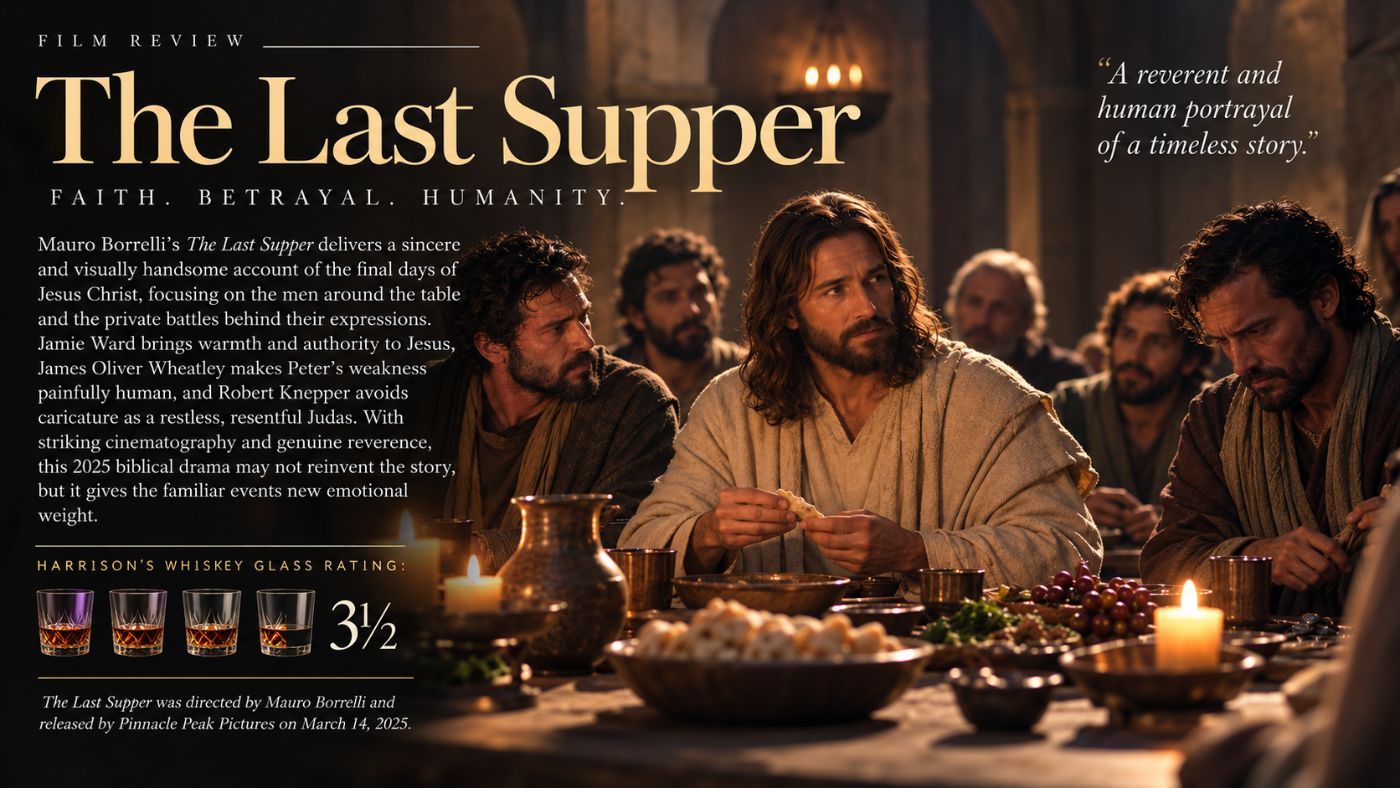
My rules for dinner are simple: decant the wine, seat enemies far enough apart to prevent litigation, and do not betray the host to the authorities before dessert. Mauro Borrelli’s The Last Supper observes only one of those rules, yet it delivers a sincere and visually handsome account of the final days of Jesus Christ without turning Scripture into a glossy Hollywood spectacle.
The 2025 biblical drama follows Jesus and his disciples through the events leading to the Passover meal, the betrayal by Judas and the Crucifixion. Most viewers already know how the evening ends, so Borrelli, who co-wrote the screenplay with John Collins, concentrates on the men seated around the table and the private battles taking place behind their expressions. The film gives particular attention to Peter and Judas, two disciples whose loyalty falters in very different ways. Peter fails through fear and later confronts what he has done. Judas makes a deliberate transaction and discovers, rather late in the proceedings, that thirty pieces of silver provide remarkably poor compensation for eternal infamy.
Jamie Ward plays Jesus with warmth, patience and authority. He resists the temptation to deliver every sentence as though it belongs on a church ceiling. His Jesus is compassionate and emotionally present, particularly during the supper, where familiar words acquire greater force because Ward speaks them to men he knows will soon abandon him. There is sadness in his performance, but also resolve. He understands the destination and continues toward it, while everyone around him struggles to comprehend what he has been telling them.
James Oliver Wheatley gives Peter a nervous, protective energy. His devotion is genuine, although his confidence proves considerably less reliable once danger arrives. Wheatley makes Peter’s weakness painfully human. Many of us have made grand promises over dinner and reconsidered them the following morning, although mine have generally involved charity auctions, exercise equipment and a regrettable commitment to attend couples’ yoga.
Robert Knepper has the more dangerous assignment as Judas. Everyone enters the theater prepared to despise him, which makes caricature an easy trap. Knepper avoids it. His Judas is restless, resentful and increasingly skilled at constructing moral arguments for the decision he already wishes to make. Each concession brings him closer to betrayal, while he continues behaving as though he is merely asking reasonable questions. I have met this personality at several private clubs. Usually the dispute concerns a membership assessment rather than the Messiah, but the expression is identical.
James Faulkner brings a cold political calculation to Caiaphas, while Nathalie Rapti Gomez provides quiet dignity as Mary Magdalene. Several supporting characters receive limited development because the film is attempting to cover an enormous amount of sacred history in 114 minutes. At times, the story moves too quickly through events that deserve greater emotional room. At others, it slows under the weight of its own solemnity. The musical score also has a habit of announcing the importance of scenes that are already perfectly capable of speaking for themselves.
Borrelli’s background as a visual artist is apparent throughout. The Moroccan locations, period costumes and warm, earthen cinematography give the production a scale that exceeds its modest budget. The feeding of the multitude, the arrival in Jerusalem and the supper itself are presented with care. The table is crowded, the room feels close and the tension grows through glances rather than theatrics. Nobody flips the table, which shows more restraint than several Palm Beach dinner parties I could mention.
My girlfriend called the film a lesson in humility and gave me a rather pointed look during the washing of the disciples’ feet. I reminded her that I had agreed to watch a nearly two-hour biblical drama without asking when the bar opened. She did not consider this evidence of spiritual progress.
The Last Supper may not offer a radically new interpretation of the Gospel, but its reverence is genuine, its strongest performances are persuasive and its central contrast between Peter and Judas gives the familiar story human weight. Peter would eventually be forgiven and welcomed back. Judas, however, would be permanently removed from my guest list, and the silver would be counted before the valet returned his donkey.
Harrison’s Whiskey Glass Rating: 🥃🥃🥃½
The Last Supper was directed by Mauro Borrelli and released by Pinnacle Peak Pictures on March 14, 2025. It stars Jamie Ward, James Oliver Wheatley, Robert Knepper, James Faulkner and Nathalie Rapti Gomez.