Office Space
Before anyone asks why I’m reviewing a modest little workplace comedy from 1999, it’s because very little coming out of Hollywood lately has given me much reason to write.
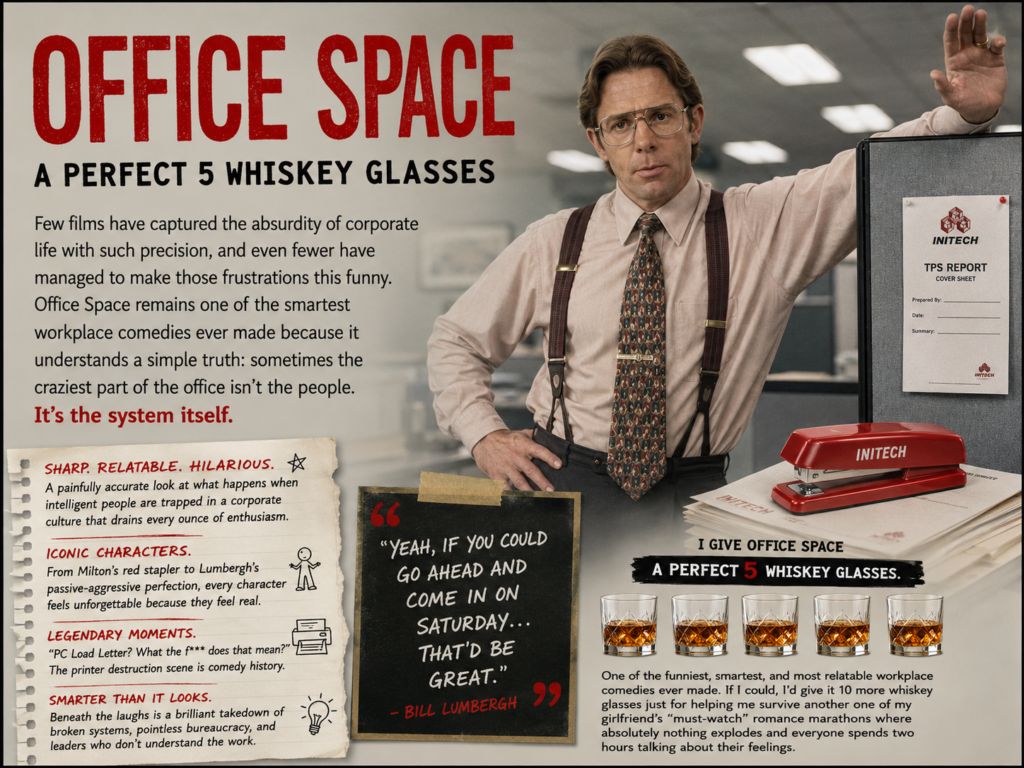
Before anyone asks why I’m reviewing a modest little workplace comedy from 1999, it’s because very little coming out of Hollywood lately has given me much reason to write. Most of it feels like the same recycled formula dressed up with a larger budget and louder special effects. Office Space, on the other hand, actually has something to say.
Admittedly, it’s been years since I’ve had any need for employment. I spent a few memorable months after Harvard effectively being held hostage in an entry-level office job. It was long enough to experience the endless meetings, baffling management decisions, broken equipment, pointless paperwork, and soul-crushing bureaucracy that is so brilliantly portrayed here. While Office Space may have been made on a shoestring budget, anyone who has ever survived a dysfunctional corporate workplace will recognize that its observations are worth far more than most modern blockbusters.
Mike Judge’s 1999 cult classic is a sharp, often painfully accurate look at what happens when intelligent people find themselves trapped inside a corporate culture that seems determined to drain every ounce of enthusiasm from the workday. While the film is exaggerated for comedic effect, its observations about workplace culture is less like fiction and more like documentary footage.
The story follows Peter Gibbons, a software employee working for Initech, a company where bureaucracy appears to have become an art form. Peter spends his days navigating a maze of managers, pointless reports, endless interruptions, and workplace policies that seem designed to make simple tasks more complicated. Like many employees who have spent years inside large organizations, he reaches a point where he begins questioning why any of it exists in the first place.
Peter’ doesn’t launch a crusade, and doesn’t become a motivational speaker. He simply stops participating in the nonsense, and exposes just how much of office culture depends on people quietly accepting absurdity as normal.
Of course, Peter is surrounded by some of the most memorable characters ever assembled in a workplace comedy.
At the center of the madness is Milton Waddams, the mumbling employee who is overlooked, and shuffled from desk to desk. Clutching his beloved red stapler as viewers watch a man pushed to the absolute edge by an organization that barely acknowledges his existence.
One of the most recognizable bosses ever put on screen, Bill Lumbergh isn’t loud or aggressive. He embodies passive aggressive management perfection. His trademark habit of wandering into employees’ cubicles with a coffee mug in hand and delivering phrases like, “Yeah, I’m gonna need you to come in on Saturday,” has become legendary. Anyone who has ever received a last minute request from management will instantly recognize the type. Lumbergh isn’t a villain in the traditional sense. He’s far worse. He’s believable.
The supporting cast is equally colorful. Peter’s frustrated coworkers, Michael Bolton and Samir Nagheenanajar, provide some of the film’s funniest moments as they navigate workplace absurdities . One scene in particular remains as satisfying today as it was when the film was released. The infamous printer destruction sequence has become one of the most iconic moments in comedy history. Armed with a sledgehammer, Peter and his coworkers take turns demolishing a malfunctioning office printer that has tormented them for months.
“PC LOAD LETTER”
The message flashes repeatedly on the printer’s tiny screen, completely baffling employees. Although it is technically instructing users to load letter-sized paper, it does so in such a cryptic, robotic way that no one understands it. For Peter, Michael Bolton, and Samir, the printer becomes a symbol of every maddening piece of office technology that seems designed to make work harder, not easier. When it spits out the infamous error during the sledgehammer scene, Samir delivers one of the film’s most memorable lines: “PC Load Letter? What the f*** does that mean?” The quote became legendary because it perfectly captured the universal frustration people felt toward office technology in the 1990s, a sentiment many still share today.
Interestingly, the printer scene wasn’t just funny because they destroyed a machine. It worked because the audience completely understood their rage. The printer had become a stand-in for every broken process, every useless policy, and every daily irritation that slowly chips away at workplace morale. That’s why audiences cheer when the sledgehammers come out. They’re not really watching three guys destroy a printer. They’re watching three guys destroy frustration itself. I suspect that is why the sequence has remained so popular for nearly three decades. It captures a fantasy most professionals have entertained at least once.
As the story unfolds, Peter and his friends begin looking for ways to reclaim control over their lives. That eventually leads them to devise a clever financial scheme involving Initech’s accounting system.
Without venturing too far into spoiler territory, the plan centers on a software program written by Peter and Samir that quietly skims fractions of pennies from thousands of company transactions and redirects the money into a separate account. The amounts are so small that they would ordinarily disappear into routine accounting adjustments and rounding calculations.
What Peter and his coworkers are really exploiting is the complexity of the very system that frustrates them every day. They understand the technology better than many of the people running the company. In a sense, the scheme becomes an act of rebellion against an organization that seems incapable of understanding its own operations.
The subplot works because it reflects another reality of corporate life. Large organizations often become so layered with procedures, policies, and management structures that few people fully understand how everything works. Systems become black boxes. Processes become rituals. Accountability becomes diluted. Office Space cleverly uses the money skimming plot to expose those weaknesses while delivering some of the film’s funniest moments.
Yet beneath all the comedy lies a surprisingly thoughtful message. People want purpose. They want competence to matter. They want leaders who understand the work being done. Most importantly, they want to feel like human beings rather than employee numbers occupying a cubicle.
That is why Office Space continues to resonate with audiences decades after its release. The technology may have changed. The office layouts may look different. Some TPS reports have likely been replaced by digital dashboards and project management software.
But, few films have captured the absurdity of corporate life with such precision, and even fewer have managed to make those frustrations this funny. Office Space remains one of the smartest workplace comedies ever made because it understands a simple truth: sometimes the craziest part of the office isn’t the people. It’s the system itself. And what makes Office Space so effective is that we’ve seen these people before.
I give Office Space a perfect 5 Whiskey Glasses. It’s one of the funniest, smartest, and most relatable workplace comedies ever made. If I could, I’d give it 10 more whiskey glasses just for helping me survive another one of my girlfriend’s “must-watch” romance marathons where absolutely nothing explodes and everyone spends two hours talking about their feelings.