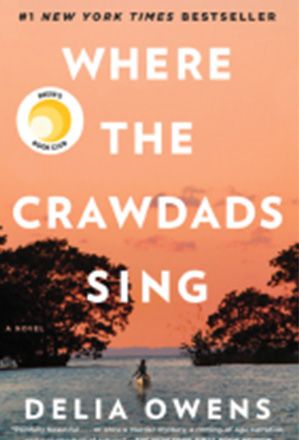
Where The Crawdads Sing
With the precision of a biologist and the soul of a poet, Delia Owens creates a place so tangible you can taste the salt in the air and hear the cries of distant herons.
With the precision of a biologist and the soul of a poet, Delia Owens creates a place so tangible you can taste the salt in the air and hear the cries of distant herons. It’s a novel steeped in atmosphere, loneliness, longing, and above all fierce, unyielding resilience.
At the center of the story stands Kya Clark, a child abandoned not once, but repeatedly, left to piece together her world in a shack at the edge of the water. Owens does not soften the blows life deals Kya. Instead, she shows us how a young girl learns to make a home from what others see as wilderness and to build a life from scraps of kindness, instinct, and curiosity. Kya grows into a woman whose intelligence runs deep, whose heart remains tender despite every reason for it to harden, and whose connection to the marsh becomes both sanctuary and identity. Her relationship with nature is not a hobby or backdrop, it is the love story that anchors the entire novel.
The book’s structure moves between Kya’s formative years and the later investigation of Chase Andrews’ death, a shift that creates a slow-burn tension that builds with every chapter. The mystery is compelling, but Owens never sacrifices emotional depth for plot. Instead, she uses the suspense to peel back layers of social prejudice, exposing how quickly a community can turn on someone it never attempted to understand.
Owens invites us so deeply into Kya’s quiet world that her joys feel like triumphs, and her betrayals land with devastating clarity. Her romance, her art, her hunger for love, for connection, for belonging are rendered with such honesty that you can’t help but ache with her. Even secondary characters feel textured and human, especially Tate, whose gentle guidance and genuine affection offer Kya her first glimpse of being seen.
Owens’ prose is lush but never indulgent. Every metaphor is purposeful, every moment in the marsh layered with meaning. The natural world becomes a mirror, reflecting the instinctive push and pull of survival, attraction, adaptation, and self-defense. In Kya’s story, biology becomes metaphor, and metaphor becomes truth.
In the end, Where the Crawdads Sing is an exploration of what it means to be othered, to be underestimated, to find strength in solitude, and to carve out beauty even when the world refuses to make space for you.
Denise Copeland and Buffey Cassidy are co-presidents of the Cambridge Book Club, a distinguished literary society in Martin County. They guide the club through thoughtful explorations of numerous works each year and host local authors to celebrate literature, cultivate community, and savor the enduring pleasures of reading.
As an Amazon Associate, we earn from qualifying purchases.