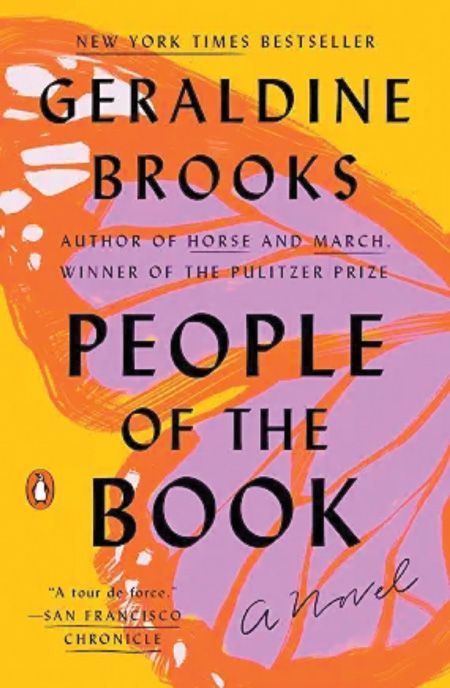
A book can reveal far more than the words written upon its pages. It can carry the stain of a family dinner, a fragment of an insect’s wing, a grain of salt or a single white hair. In Geraldine Brooks’ extraordinary novel People of the Book, these nearly invisible remnants become witnesses, offering clues to the long and dangerous journey of one of the world’s most remarkable manuscripts.
The novel begins in Sarajevo in 1996, shortly after the Bosnian War. Hanna Heath, an Australian rare-book conservator, has been invited to examine the Sarajevo Haggadah, a beautifully illuminated Jewish manuscript rescued during the shelling of the city. Hanna is brilliant, guarded and far more comfortable with parchment, pigments and bindings than with the unpredictable demands of human relationships. To her, conservation is both science and detective work. Every stain, fiber and irregularity may contain part of the book’s history.
The Haggadah is a Jewish ceremonial text used during the Passover Seder to recount the Exodus from Egypt. The real Sarajevo Haggadah is believed to have originated in medieval Spain and is remarkable for its richly colored illustrations. Its survival seems almost improbable. It endured the expulsion of Jews from Spain, scrutiny during the Inquisition, Nazi occupation and the destruction surrounding the siege of Sarajevo.
Brooks uses those astonishing facts as the framework for an ambitious work of historical fiction. As Hanna studies the manuscript, she discovers several tiny mysteries within its binding: the wing of an unusual insect, wine stains, traces of salt and a white hair. Each clue opens a door into another century, allowing Brooks to imagine the people who created, owned, protected, damaged and ultimately saved the book.
The construction is particularly clever. Hanna’s story moves forward while the Haggadah’s story travels backward. The reader begins with its rescue in wartime Sarajevo, then follows it to Vienna in 1894, Venice in 1609, Tarragona in 1492 and finally Seville in 1480. With every step into the past, the manuscript becomes less of an artifact and more of a living record of the hands that touched it.
In wartime Bosnia, a Muslim museum curator risks his life to keep the Jewish volume from the Nazis. In Vienna, the book passes through a world of scholarship, prejudice and private desperation. In Venice, a Catholic priest charged with examining Jewish books for heresy must decide if the Haggadah will survive the Inquisition. In Spain, Jewish families confront forced conversion, exile and the destruction of a society in which Jewish, Muslim and Christian traditions had once existed in uneasy proximity.
The earliest portion of the story provides the novel’s most affecting revelation. Brooks imagines that the Haggadah’s luminous paintings were created by Zahra, an enslaved Muslim woman whose artistic gifts would otherwise have disappeared from history. Her work on a Jewish manuscript becomes an assertion of identity and a quiet refusal to be erased. The suggestion that a Muslim woman may have illustrated a Jewish sacred text using artistic traditions shared across cultures captures the novel’s central idea: history is rarely as orderly or divided as later generations would like to pretend.
Brooks does not present the Haggadah as a pristine object carried reverently through time. It is spilled upon, rebound, censored, hidden, stolen and handled by frightened people making dangerous choices. Its imperfections become its biography. The wine stain recalls a table and the people gathered around it. Salt carries the memory of flight and loss. The insect wing connects the manuscript to a particular landscape. The white hair leads Hanna toward the artist whose name history nearly forgot.
Hanna’s contemporary narration keeps this sweeping chronology grounded. Her investigation develops alongside a complicated relationship with Bosnian librarian Ozren Karaman and an increasingly painful confrontation with her formidable mother. Hanna has devoted her career to repairing damaged books, yet she has done little to examine the fractures in her own life. As the manuscript yields its secrets, her professional certainty begins to collide with questions of family, trust and belonging.
The modern storyline occasionally ventures into more conventional territory, particularly when romance, forgery and family revelations begin arriving in quick succession. Yet Hanna remains an effective guide because she teaches the reader how to look. Through her, a cracked clasp or discolored fiber acquires the suspense of a recovered letter. Her precise observations give Brooks a natural passage between laboratory science and historical imagination.
The title refers first to the Jewish people, traditionally known as the People of the Book, but Brooks steadily expands its meaning. The “people” are also the Muslims, Christians, scholars, artists, refugees, librarians and conservators whose lives become bound to this particular volume. Some attempt to destroy it. Others protect it at immense personal risk. Together, they form an unlikely community separated by centuries but joined through a single object.
People of the Book is ultimately a novel about survival, though not the clean, triumphant variety. The Haggadah survives because imperfect individuals decide, sometimes at considerable cost, that beauty, memory and knowledge deserve protection. Brooks transforms a rare manuscript into a witness to exile, prejudice, courage and cultural exchange. The book has no voice of its own, yet every mark upon it speaks.
As an Amazon Associate, we earn from qualifying purchases.