Horse
For a horse who competed in only seven official races, Lexington secured an extraordinary place in American history.
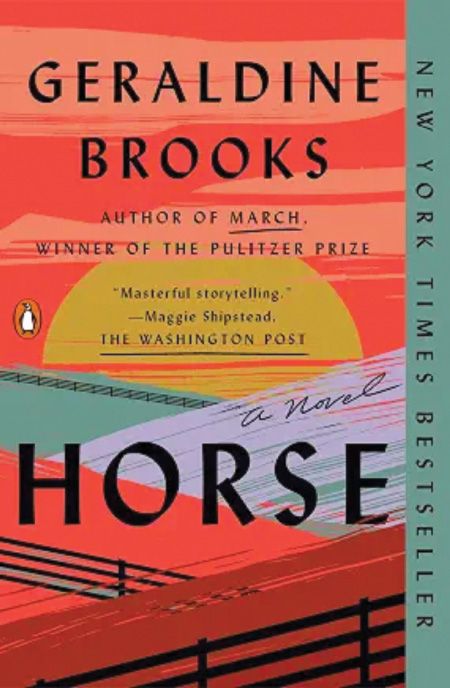
For a horse who competed in only seven official races, Lexington secured an extraordinary place in American history. His victories filled newspapers, artists painted his likeness, and breeders coveted his bloodline. In Horse, Geraldine Brooks examines the knowledge and labor behind that glory, particularly the contribution of the Black horsemen who cared for him. She connects their lives to two people in modern Washington whose growing affection exposes how differently they experience the same country.
Born in Kentucky in 1850, Lexington began life as Darley, a colt bred by Dr. Elisha Warfield. At New Orleans’ Metairie Race Course in 1855, he covered four miles in seven minutes, 19¾ seconds. He won six of seven starts before deteriorating eyesight ended his racing career. At Woodburn Stud, he became North America’s leading sire for a record sixteen years, including two after his death. Nine of the first fifteen Travers Stakes winners were his offspring. Lexington died in 1875, aged twenty-five.
Brooks builds the historical story around Jarret, an enslaved groom whose future becomes bound to the horse’s. Her fictional Jarret is the son of Harry Lewis, a real Black trainer who had gained his freedom and helped develop the young horse. A real groom named Jarret appears in descriptions of a lost Thomas J. Scott painting, but little is known about his life. Brooks constructed his character using records of other accomplished Black horsemen. That distinction matters: Lexington’s achievements were preserved in detail, while the man caring for him received so little attention that a novelist had to reconstruct his story.
Jarret gives these chapters their emotional force. He understands Lexington’s moods, recognizes discomfort and protects him when an owner’s ambition threatens the animal’s welfare. His expertise earns responsibility without securing control over his own future. Owners can sell him, and every transaction threatens their bond. As Lexington loses his sight, his trust in Jarret becomes especially moving. Brooks gives their companionship tenderness while keeping the brutality of enslavement plainly in view.
Lexington’s remains eventually entered the Smithsonian’s collections, where his identity receded behind his use as a specimen. Later examination revealed evidence of an abscess associated with his blindness. His skeleton returned to Kentucky on loan in 2010. Brooks shifts that chronology for her 2019 storyline. Jess, a white Australian scientist, studies his skeleton, while Theo, a Black Nigerian American art history graduate student, investigates a discarded horse painting. She examines the animal’s structure; he considers the representation of the Black people working beside him.
Their first encounter gives the romance an uncomfortable foundation. Seeing Theo unlocking an expensive bicycle identical to hers, Jess suspects theft. Her own bike is farther along the rack. She does not openly accuse him, but Theo recognizes her assumption. Jess is mortified; he recognizes another familiar encounter with suspicion. Her embarrassment cannot erase the fact that she judged him before knowing anything about him.
When research brings them together again, attraction develops through museum visits, meals, conversation and physical intimacy. They argue about art, recover their humor and become interested in each other’s minds. These ordinary exchanges make their affection convincing. Yet Theo must decide how much vulnerability he can offer someone who has already misread him. Jess must hear experiences that unsettle her view of herself. His education, diplomatic family and Oxford polo background offer little protection against strangers’ assumptions.
The ending makes that vulnerability devastating. A police officer fatally shoots Theo while he is helping an injured woman, interpreting him as an attacker. The bicycle encounter acquires a terrible echo, although the consequences differ profoundly. Jess’s grief exposes how much of Theo she was still discovering. This is also where I have reservations: his death risks becoming chiefly an education for her and the reader. The intimacy and discomfort of their developing relationship offer a richer examination of misunderstanding.
Horse is strongest when Brooks gives these lives individual attention: Jarret’s intelligence, Lexington’s dependence on him, Theo’s ambitions and Jess’s imperfect efforts to understand. Its shifting periods sometimes interrupt the compelling stable-yard story, but they also bring neglected evidence into view. A painting, a pedigree and a damaged skull become reasons to reconsider whose achievements history has preserved.
As an Amazon Associate, we earn from qualifying purchases.